A civil wedding gives you incredible freedom – and that’s exactly why there are often many questions when planning one. How does a civil wedding work? How much does a wedding officiant cost? When should you choose the music for your wedding? And what actually happens if it rains on the wedding day?
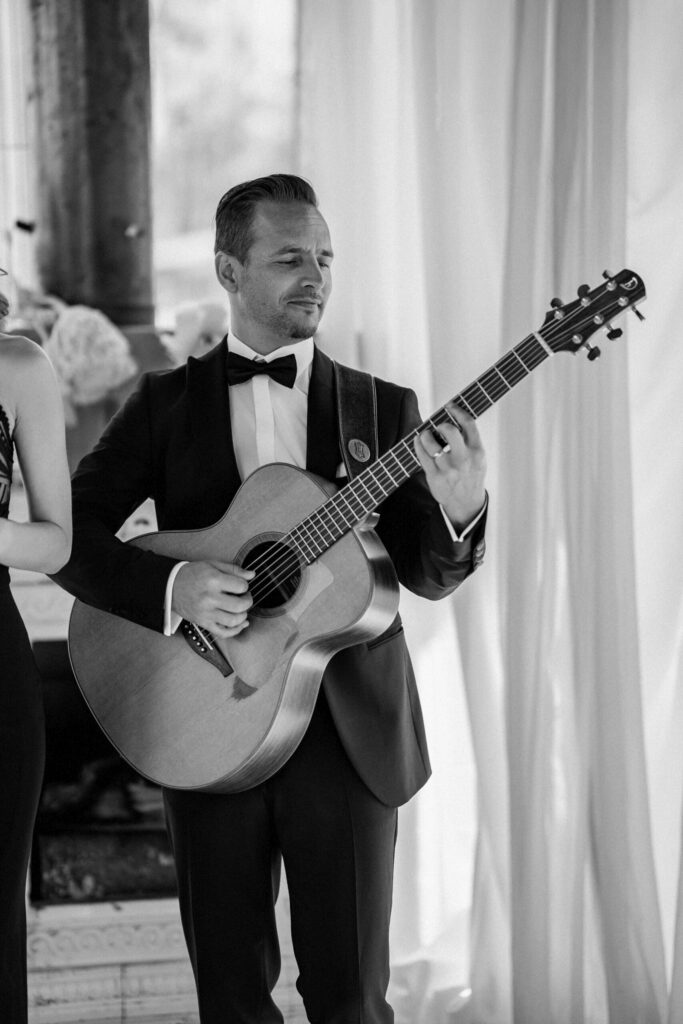
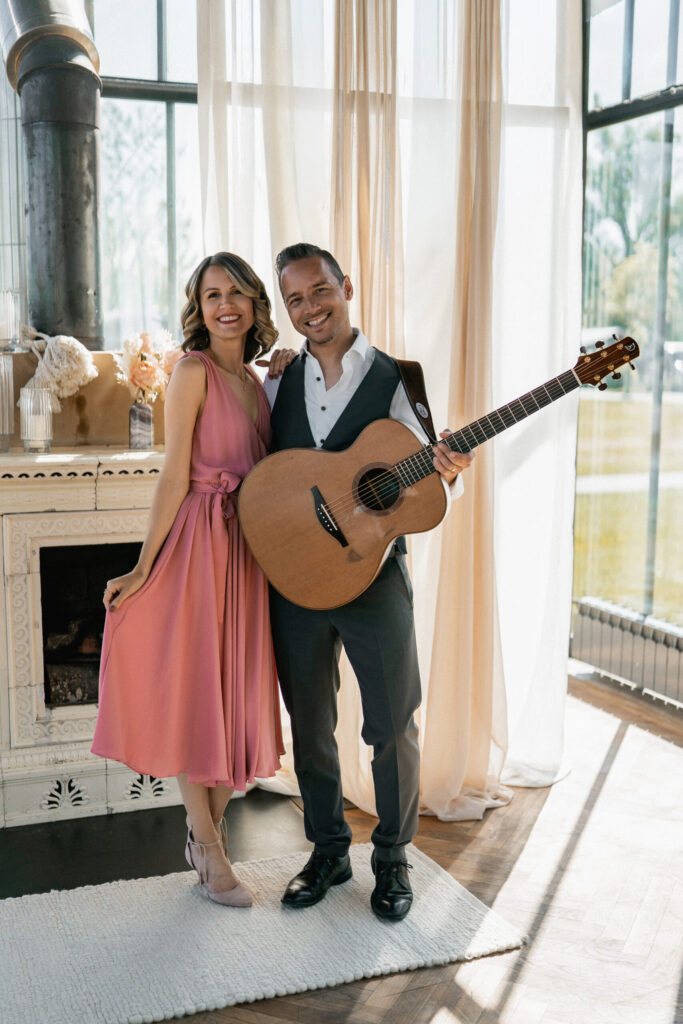
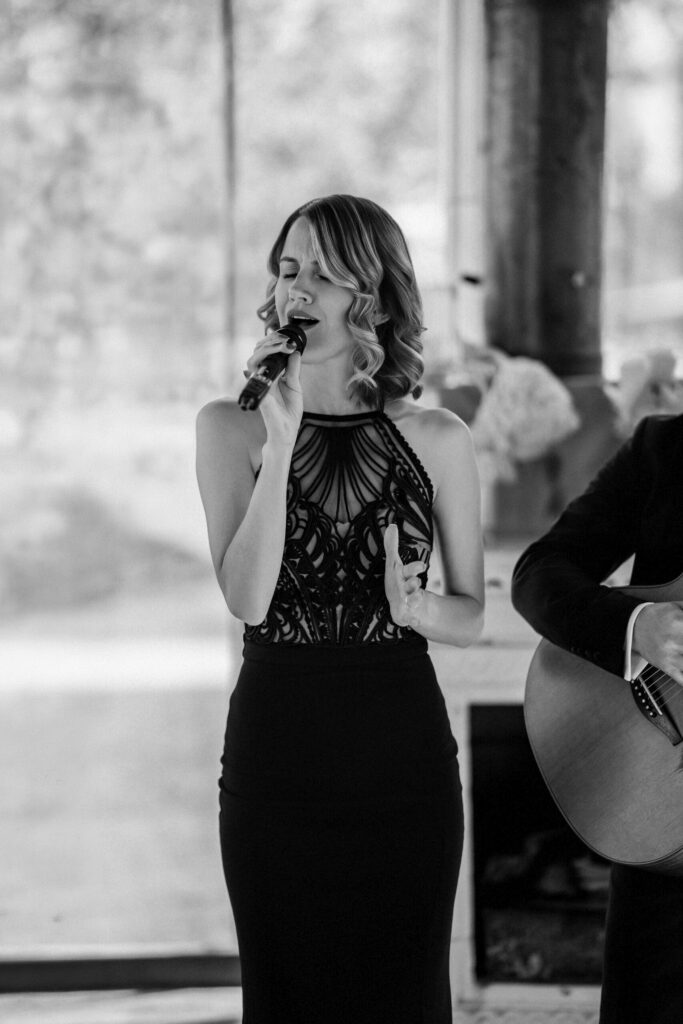
We are Sabrina and Martin from Calathea Moments and have been assisting with free weddings and celebrations for over 11 years. We have now been able to participate in more than 800 ceremonies and events – Martin as a wedding officiant and guitarist, Sabrina as a singer. We constantly see what questions couples ask before their wedding and what decisions really make a difference later on.
In this FAQ, we have therefore collected the most important questions about civil weddings, wedding officiants, live music, costs, and planning. You can jump directly to the topic that is currently bothering you: Each question begins with a brief answer, followed by a more detailed explanation of the background and our practical experience.
Whether you are looking for a solo performer or would like to combine speech and live music: at Calathea Moments you can book the individual services independently of one another. In one Free, no-obligation consultation Let’s work together to determine what suits you and your wedding.
Basics: What is a free wedding ceremony?
What is a free wedding ceremony?
A civil wedding is a symbolic ceremony that you can design according to your own wishes, without a fixed schedule, without religious requirements, and in a place of your choice.
Those who choose a civil wedding go in a different direction deliberately: away from traditional requirements, towards a ceremony that suits you as a couple. Unlike a church wedding, there are no liturgical elements. Unlike a civil registry office, where a sober, legal explanation usually takes center stage, there is no time pressure and no formal language. Your values, your history, and your connection are the focus.
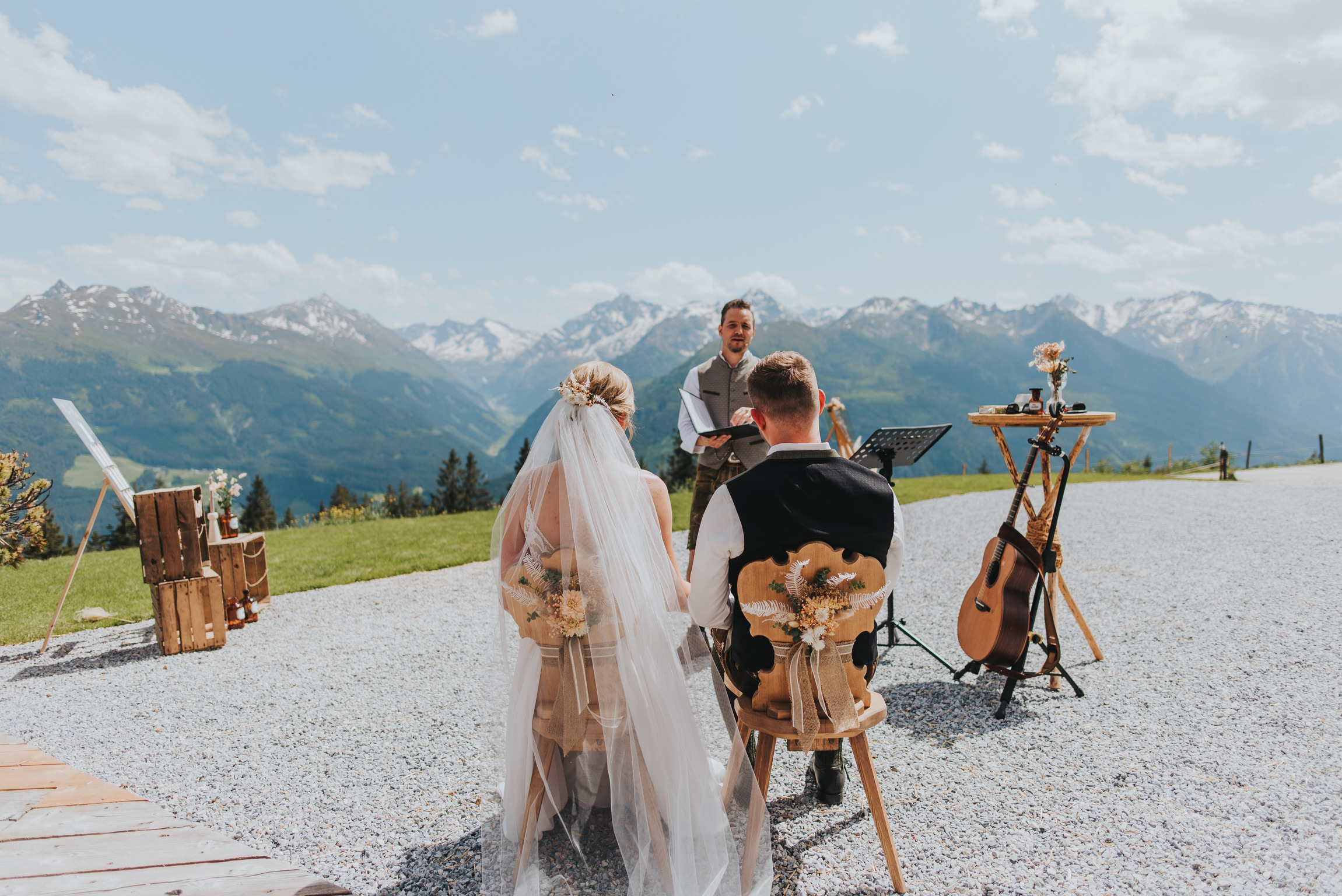
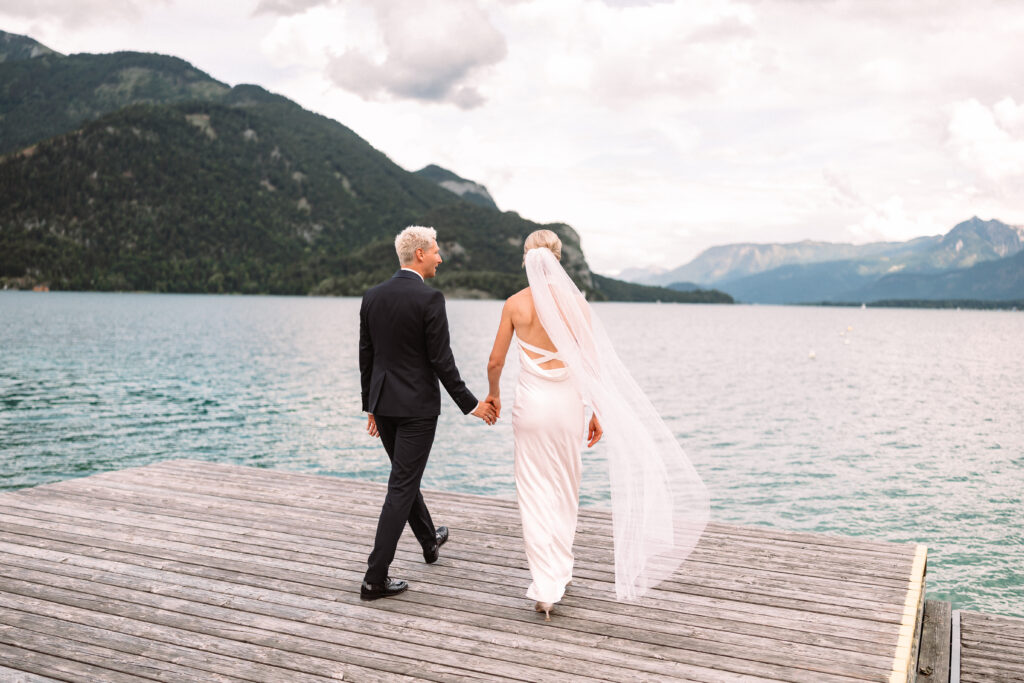
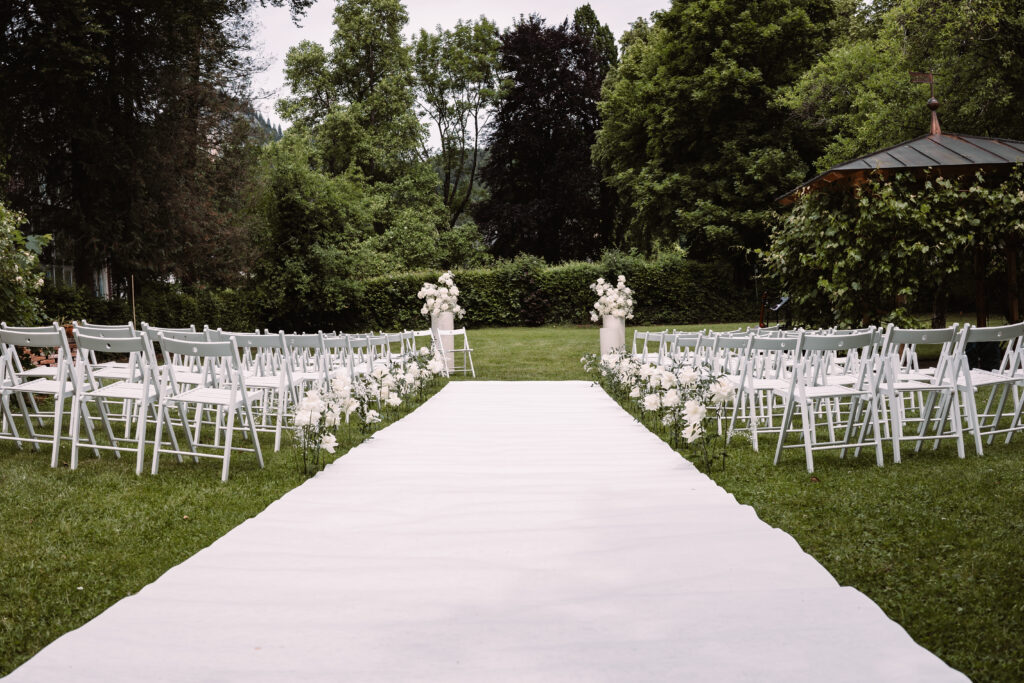
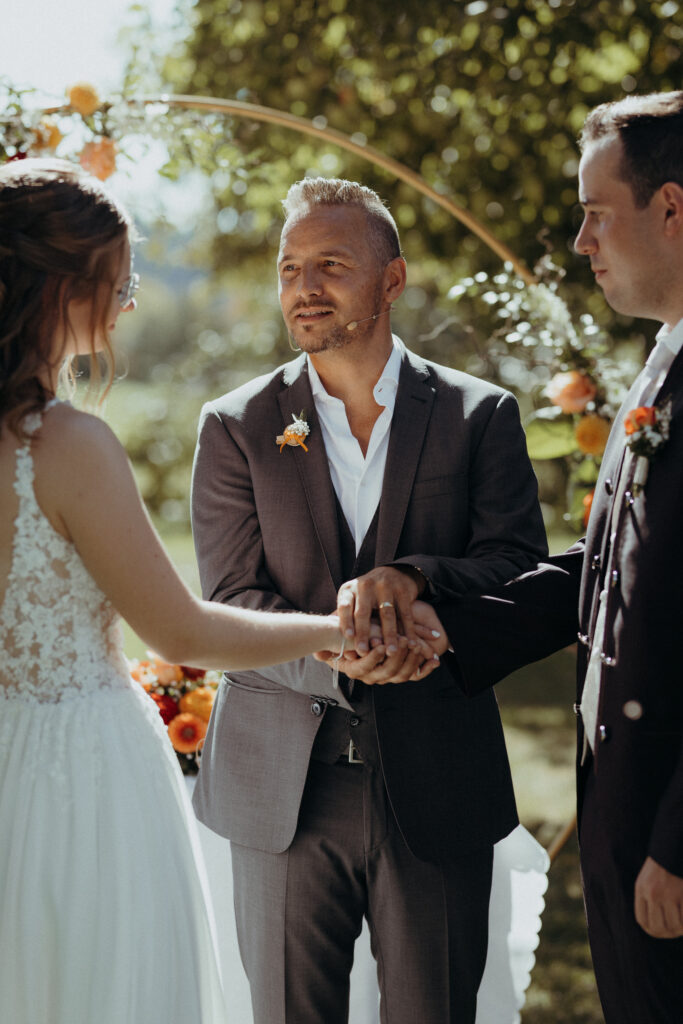
You determine the framework: the words, the rituals, the music and contributions from family and friends. You decide how the entrance takes place and which symbols play a role. The location is also freely selectable. Your ceremony can take place on a mountain pasture, at a mountain lake, on the beach, in a villa or in a landscaped park.
The crucial question is therefore not whether it is done by a civil registrar or on a voluntary basis, but: How would you like to remember your wedding? The ceremony is the moment when all the guests are present at the same time and focus entirely on you. That is exactly why it should be the centerpiece of the day. You can see how we design such ceremonies on the page Weddings.
Is a civil wedding legally valid?
No. A civil wedding has no legal effect in either Germany or abroad. Your marriage will only be legally binding through the civil wedding ceremony.
This applies regardless of the location: Whether the ceremony takes place in Bavaria, on a vineyard in Italy or on a beach in Portugal, it is purely symbolic. Anyone who only celebrates a civil wedding is not formally married.
Many couples therefore choose to deliberately make the civil registry office a small, formal act, often in a close circle. The free ceremony then becomes a big emotional moment with family and friends. The advantage of this arrangement is that you have complete freedom of design and are not bound by legal requirements. You decide where the ceremony takes place, who conducts it, and how personal it becomes.
In Italy too: Civil marriage is not legally binding. Anyone who wants to be officially married must first go to the registry office, either in Germany or locally. More about this in our articles on: free marriage in Bavaria and to Free wedding ceremony abroad.
Do you have to get married in a civil ceremony?
Yes, if your marriage is to be legally recognized. The simplest solution is to have it done at the registry office before or after the civil wedding in Germany.
This way, you can focus entirely on your day during the free ceremony and don’t have to deal with bureaucratic procedures in the host country. This also provides you with planning certainty.
At a wedding abroad, civil marriage registration is possible locally, but it is more complex. In many countries, you need multilingual documents, international birth certificates and marriage certificates, and sometimes an Apostille. These documents must be applied for early and are usually valid only for a limited period of time. In some countries, additional requirements include a period of residence in the country or a personal meeting with the authorities. In Italy, for example, documents must be translated, certified, and submitted weeks in advance, and the deadlines are limited.
However, there are also locations where both of these can be combined. For example, at the Almbad Huberspitz above the Schliersee, a civil wedding ceremony is also possible. Our advice: First determine whether you want a symbolic ceremony or a legal wedding ceremony, and plan accordingly. This saves you unnecessary bureaucracy shortly before the big day. Further information can be found in our article on Free wedding ceremony abroad.
Who is Calathea Moments?
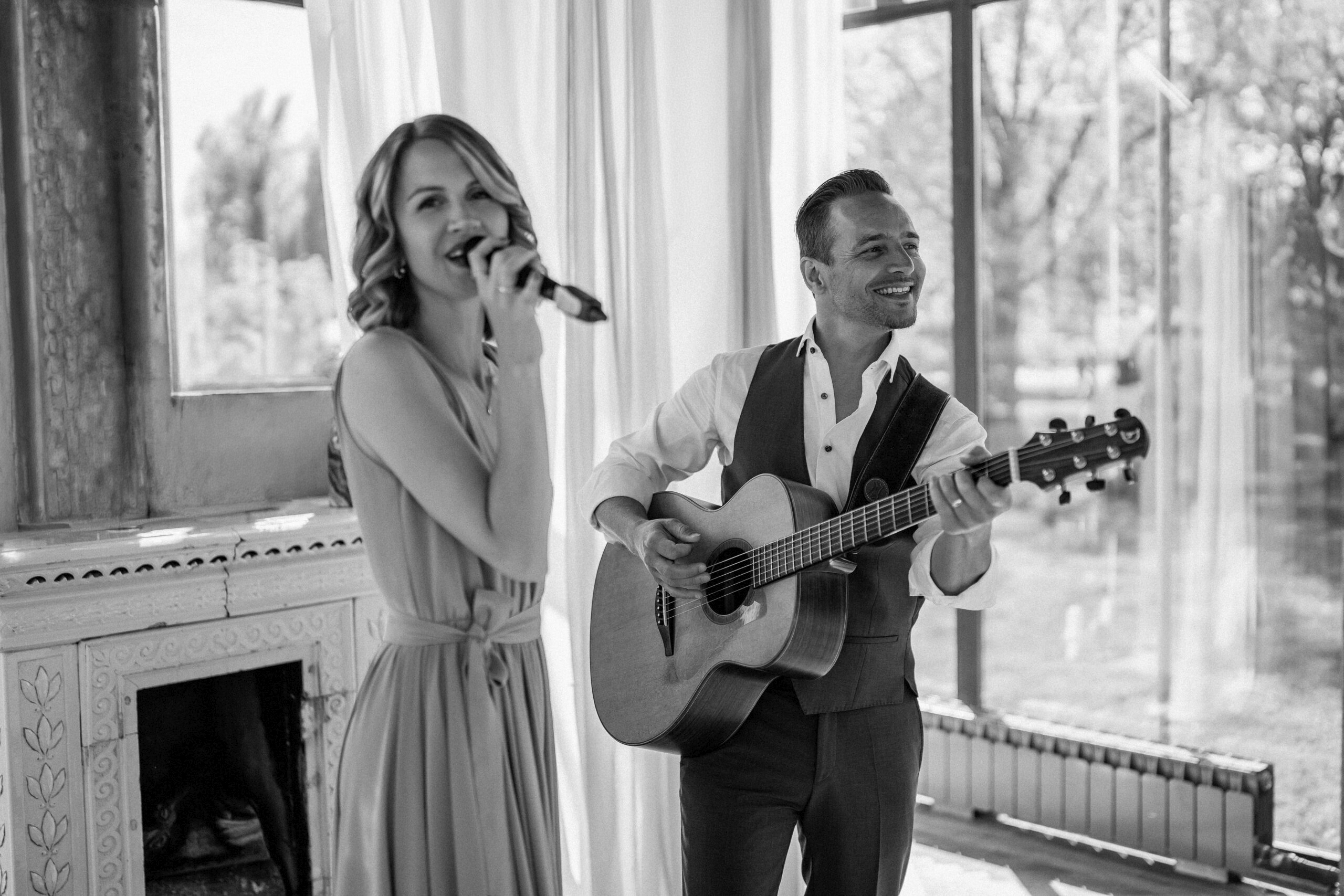
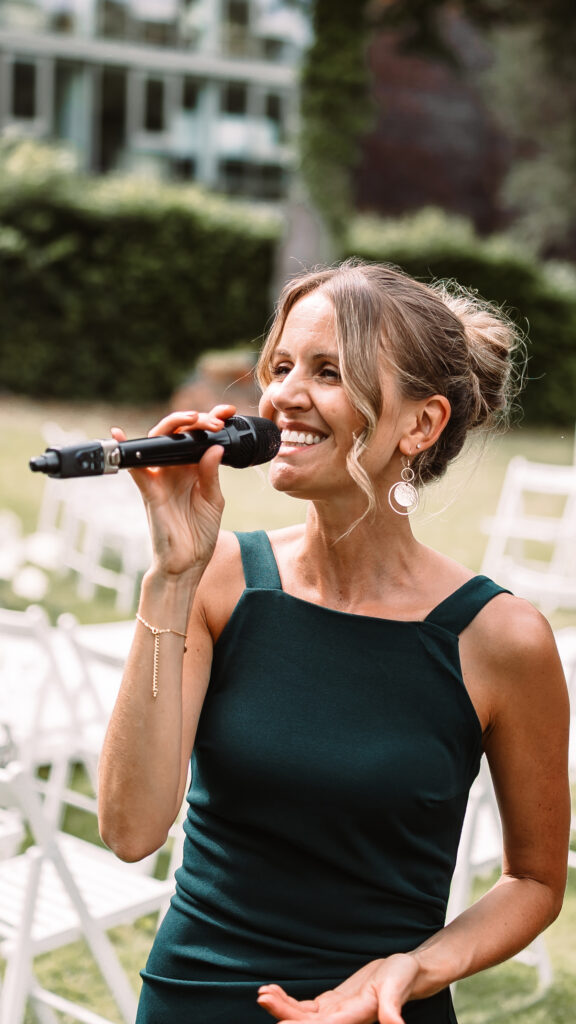
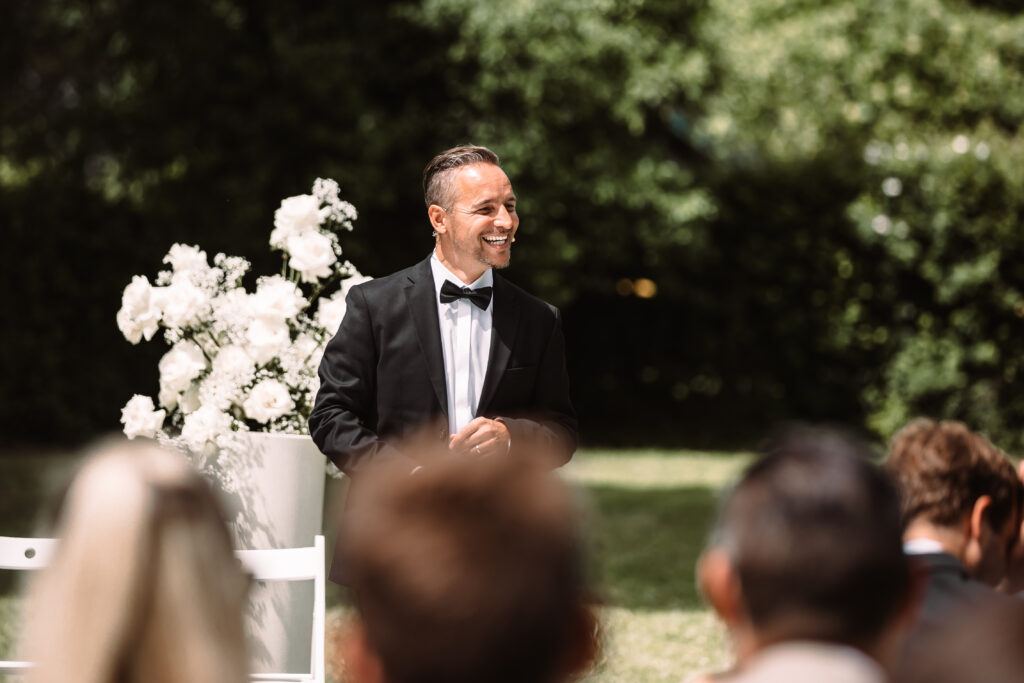
Calathea Moments are Sabrina and Martin: Martin is a free-spirited wedding officiant and a trained guitarist, while Sabrina is a trained musical performer and singer. We have been arranging weddings and celebrations for over 11 years.
So far we have accompanied over 800 ceremonies and celebrations: weddings in southern Germany, Austria and Switzerland as well as abroad, from small, intimate ceremonies to large celebrations. In addition, we have organized company parties, gala evenings, anniversaries, concerts and funeral ceremonies. In funerals and burials, we tell the story of that one person through words and music.
We are married ourselves. This influences our work, because we know what nervousness feels like, what moments count and which words really touch people. Because we have the same two people speaking and playing music, we don’t create a ceremony from individual program elements, but a continuous story.
Our claim: A wedding is not a program, but a promise. Our task is to give this promise a voice and a sound. You can find out more about us on the page About us, Do the votes of former couples count? References. In our podcast „Oh Happy Day“, we also tell wedding stories.
What does „speech, music and moderation from a single source“ mean?
You don't book individual program elements, but a day that fits together: Martin writes the speech and runs through the schedule; Sabrina and Martin play the music live. You have a contact person, a contract, and an invoice.
This applies to the wedding ceremony as well as to the reception, dinner, or opening dance. You decide how much of it you want, and we will honestly tell you what we have learned from our experience is truly meaningful. Speech, live music, and moderation form three components: an individually written wedding speech, songs that are sung and played live, and an accompaniment that keeps track of time, guests, and service providers.
The practical advantage: You don't have to coordinate anything, adjust anything, or think about anything. Instead of having conversations with multiple service providers, you have one central contact person for the entire ceremony. On the wedding day, you can sit back and enjoy the moment, almost like guests at your own wedding.
Important: The combination of speech and music works best; however, each component can be booked separately. We cater to your day, not a fixed package. You can find the overview on the page. Weddings.
Why is it worth booking a wedding band and a wedding musician together?
Because speech and music are developed together from the very beginning. Transitions become smoother, the mood remains stable, and the ceremony feels like it was designed together.
The most common mistake in free weddings with live music is the separate planning. The couple hires a speaker and a musician, both briefly explain the schedule once, and afterwards each prepares their own part. To the guests, it seems like a series of individual sections, a change between speaking and playing without any discernible connection.
When speech and music come together, things change. Songs are not simply played, but adapted to the moment. Tempo, volume, and emphasis are adjusted according to what is happening at the time. The music doesn’t start after the speech; it can be quietly inserted below the final words or take on the content. The speaker can introduce a song in terms of content, so that the guests are prepared when the music begins.
In addition, there is flexibility: because we know and manage the entire process, we can react immediately in the event of weather changes or delays. For you, this means less coordination effort and often a better price-performance ratio than with separate bookings. We explain how this works in the article. Free wedding ceremony with live music: What should you keep in mind?

Wedding officiants: selection, talks and speeches
What should I consider when choosing a freelance translator?
Chemistry and trust are most important: You should feel understood and know that the speaker is interested in your story and not spreading his standard program.
Booking a free interpreter basically means trusting a stranger to convey your love to them in a way that it resonates with you and your guests. Often, you can tell in the first few seconds of a conversation whether it’s a good fit. Ask yourself: Does the speaker speak from the heart? Do I feel understood? Or is he trying to impose his standard program on me?
During the initial meeting, pay attention to who is the focus of the conversation. Does the speaker mainly talk about themselves, their achievements, and their concept? Or does he or she ask about you, your story, and your wishes? A good first conversation doesn’t feel like a sales pitch; it feels more like a conversation with someone you know.
A good wedding officiant can do more than just string beautiful words together. He becomes the master of ceremonies who brings the atmosphere of a wedding to life and has a sense of timing. On top of that, there’s the music: A speaker who can incorporate live music often makes the ceremony more harmonious. And one more thing: Budget plays a role, but it shouldn’t be the sole deciding factor. If the chemistry isn’t right, even the most expensive speech won’t make a difference. You can find the detailed checklist in the post Booking a celebrant: What to look out for when choosing.
How do I recognize whether a eulogy is unique or consists of text fragments?
Specifically ask how the speech is created: Is there a fixed routine for all couples or is each speech written individually? Be assured that your ceremony will be unique.
One of the most important questions when choosing a speaker: Do you want something special for yourself, something original, or something standard? The difference is often clear during the initial discussion. Ask about the speaker’s working style, whether he uses templates, and how many personal conversations are planned.
Feel free to ask for examples or references. However, don’t be fooled by beautiful wording; instead, make sure that you are assured that your ceremony will be unique and not a copy of another’s. A hint is also provided by the time the speaker takes: The more preparation, the more personal the speech will usually be.
We don't have a template or a building kit. Martin comes to your home, listens, asks questions, even where it gets uncomfortable, and turns it into your own speech. You can find reviews from previous couples here. References.
What questions should we ask during the initial meeting with the wedding coordinator?
They ask about the process from booking to the wedding ceremony, the number of personal conversations, working with templates, the role of music, and what happens if something goes wrong on the wedding day.
To help you get started well prepared for the conversation, here are the most important questions:
- How does the process of booking the wedding from the moment of booking to the wedding day go?
- How many personal conversations are planned?
- How does the speech actually come about? Do you work with templates?
- Can we read or hear the speech beforehand?
- What role does music play in the ceremony?
- How flexible are you in accommodating individual requests?
- What happens if we are nervous on the wedding day or something goes wrong?
A professional ceremony master answers all of these questions openly and transparently. Also pay attention to how he answers: honestly and specifically or evasively?
With us, you’ll get these answers already in the first phone call. We explain how Martin works, what information we need from you, and how the live music emotionally enhances your ceremony. This is part of our free and non-binding introductory conversation about the Contact page.
How does the engagement discussion go?
The funeral service takes place at your home and often lasts two to three hours. Martin gets to know you and learns the things that make a speech personal.
We’re not going through a standardized questionnaire. It’s about getting a real sense of who you really are as a couple. We talk about what connects you: your unique traits, what you love about each other, your way of showing affection, and also how you handle difficult times. Martin asks about that too, even when it gets uncomfortable. That’s often where the strongest moments of a conversation arise.
Often we involve groomsmen or parents. Not out of curiosity, but to hear other perspectives: how they interact with others, what friends and family value about them, and what aspects might only become apparent through shared interaction. These impressions are subtly incorporated into the speech and make it more complete.
From these conversations comes a speech that is honest, with depth, with humor where it belongs, and with seriousness where it is needed. This is exactly what distinguishes a speaker of truth from someone who simply strings together beautiful words. Further background on this can be found here: free marriage in Bavaria.
How many meetings are usual before the wedding?
With us, there are one or two personal meetings. The rest of the communication takes place via video calls and WhatsApp, and just before the wedding we still phone each other.
The initial step is a get-to-know-you phone call; depending on the occasion, a video call follows. You’ll see if the chemistry is right and we’ll work out the details. The personal meeting is the engagement ceremony at your home: here we delve deeper, you tell your story and discuss your wishes. An optional second meeting can be used for final arrangements or a rehearsal.
We stay in touch via video call and WhatsApp between the conversations. Shortly before the wedding date, we will call you again. This phone call is intended to give you reassurance and transform the nervousness into anticipation.
After booking, we take care of the planning and contact you in good time to discuss the details of the ceremony, the choice of songs, and the execution of the event. You don’t need to keep track of any deadlines. However, allow for plenty of time in advance: the intensive preparation often begins a year before the wedding. The earlier we start, the more time we have to think about your ceremony.
How personal will the eulogy really be?
As personal as you allow it. The more you tell us about yourself, the more authentic the conversation becomes, including special moments and intimate details.
A truly personal, intimate wedding speech can only be given with confidence. You may have to tell your wedding officiant things that you wouldn’t immediately say to a stranger. However, it is this very confidence that is necessary for the speech to suit you and for your story to come across authentically.
That’s why Martin has intensive conversations with each couple, in which they can tell their story, share special moments, and also discuss intimate details. He takes the time to get to know your personalities and understand the unique details of your relationship. Only then do words emerge that truly capture what makes you unique.
You decide for yourself how much you share. The important thing is that you feel comfortable. If after the first conversation you have the feeling that the speaker already knows you a little bit, that’s a very good sign. For more information, see the post Book a free funeral director.
How long does a free wedding ceremony take?
Plan realistically 45 to 60 minutes for the entire ceremony. It consists of more than just the speech.
That sounds like a lot, but it really is. The ceremony includes the arrival of the guests, who sit down and get into the mood. Then comes the procession with music, there are moments of silence, possibly a ritual, then the speech itself, more music, and the departure. If this part is planned too loosely, it can get hectic.
The ceremony doesn’t start with the first words, but already at arrival. How are the guests received? How do they find their seats? Is there a clear guide or is there confusion? In our experience, it makes a huge difference when someone takes the guests on from the very beginning, leads them into the moment, and consciously builds the mood.
The ceremony is the only moment when everyone is really there and fully focused on you. Give them the space they need. Also, plan some time in between the ceremony, the reception, and the other program events, because many guests want to take photos or let the moment unfold for themselves. More about this in the post on Wedding in Italy.
How does a free wedding ceremony work?
A typical ceremony consists of the entrance, greeting, personal speech, possibly a ritual, the marriage vow, the exchange of rings, the "yes" word, and the exit. You decide which elements you include.
A civil wedding has no set rules; you decide for yourself how you want to experience the moment. That is why a clear structure is so important, so that the ceremony runs smoothly, is personal, and is well-organized. Your wedding officiant will help you develop this structure together. The important thing is that you feel comfortable with the order and that the flow fits your story.
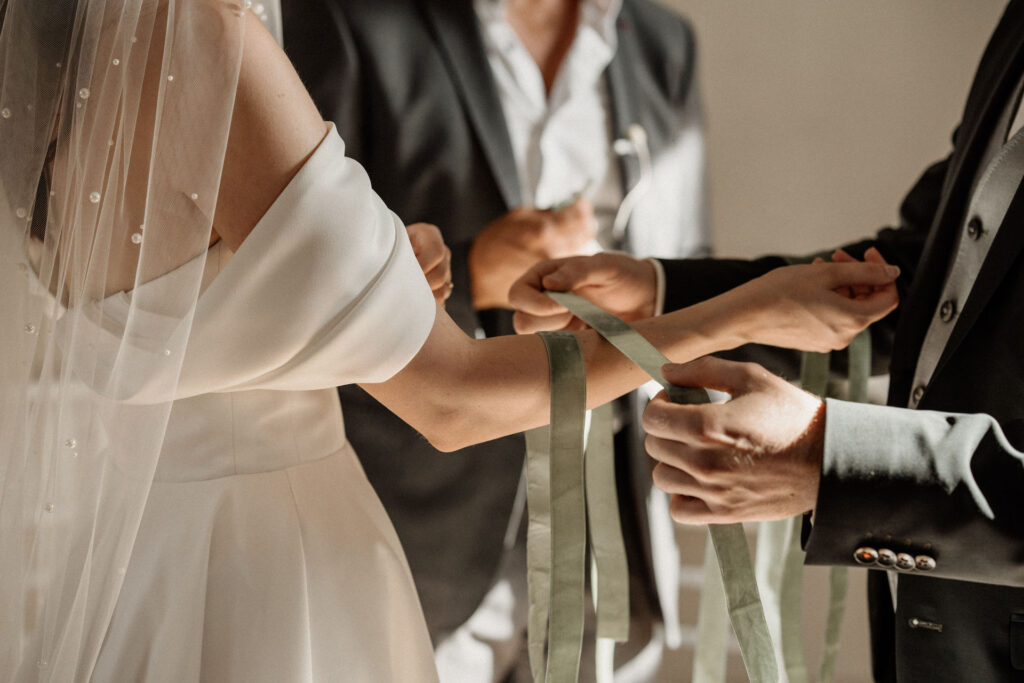
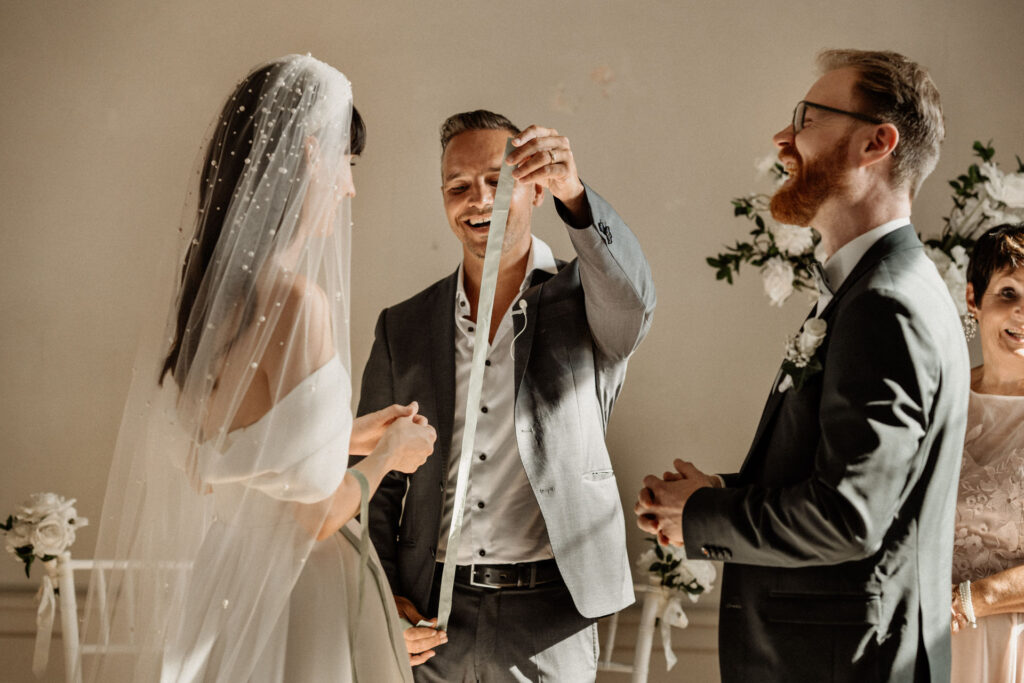
Rituals can enrich the ceremony, but only if they are used consciously. We do not rely on standard rituals, but on individual rituals that suit you as a couple. Often these are small „signifiers“ for your marriage that remind you later in everyday life of what you have promised and how beautiful those moments were. A ritual should not be built on a sense of duty, but because it expresses something that is important to you. Contributions from friends or family members also make the moment personal and accessible.
Details like seating arrangement, shadows, timing, and paths determine how the day unfolds. Where do you stand as a couple? Where do the guests look? Is there a natural stage or does one have to be created? And music is not a background element. It connects transitions and keeps the mood going, for example during the entrance, the wedding vows, and between the speeches. Upon request, we can coordinate the speech, music, and moderating with each other. How that sounds, you can hear in our Audio samples.
How do we convince sceptical family members to have a free wedding ceremony?
Take the concerns seriously and talk about them early on. The skepticism usually comes from a lack of certainty, not from rejection.
Especially in traditionally-oriented families, such as those in Bavaria, church weddings have been deeply rooted for generations. Many assume that a wedding will take place in church. The concern that something is missing or that the ceremony is not taken seriously often resonates subtly. The typical questions are: How does it work? Is it dignified enough? What do the others say?
Anyone who ignores this risks a tense atmosphere on the wedding day. Many weddings fail not because of the organization, but because of the communication beforehand. Our experience shows that it helps to involve the family early. Invite parents and relatives for a conversation where we, as the wedding celebrant, can be present, explain how a relaxed wedding takes place, which rituals can be integrated, and how it becomes personal. Martin also sometimes conducts conversations with parents or witnesses on his own initiative to bring different perspectives into the speech.
The more your family is involved in the process, the more likely they will understand that a civil wedding is not a rejection of tradition, but a modern, loving interpretation of it. And a side effect: Guests who have never experienced a civil wedding often react particularly strongly because they did not expect something so personal. More about this in the article free marriage in Bavaria.
Live music and wedding songs
Do we need live music, or is a playlist sufficient?
A playlist can work, but it remains static. Live music adapts to the moment; it reacts to you and your guests.
If the bride takes longer to arrive than planned or a particularly emotional moment takes longer, the playlist may not respond. The band's playback always sounds the same, no matter what is happening at the moment. This is exactly how the guests feel: The music feels like a backdrop, not a part of the ceremony.
The difference lies in the feeling as well. Later on, we don’t remember the exact words of a wedding ceremony, but rather how we felt. Words reach us in our minds, explaining and organizing them. Music directly touches the heart. Live music opens up the emotional space for it. If the music is missing, the ceremony often remains strangely cold, even if the words are beautiful. The guests listen, nod, but don’t really get emotionally involved.
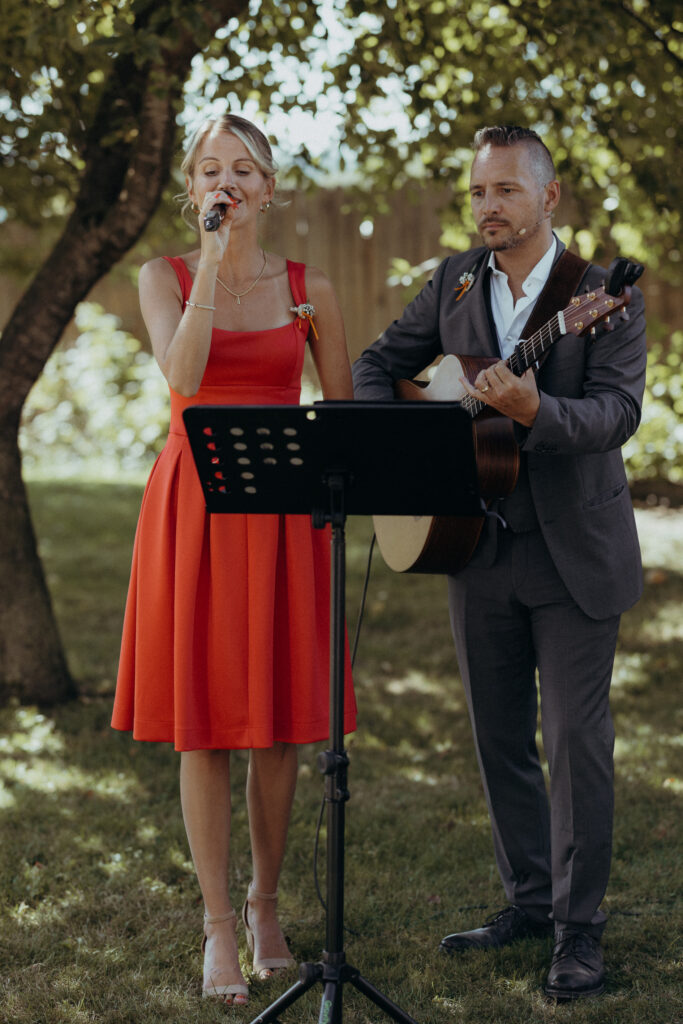
Of course, live music isn’t automatically good just because it’s live. A good wedding musician takes a back seat and enhances the moment, rather than trying to be the center of attention. He observes and feels when a song should begin and how loud it should be. This very attitude is what we mean by a live accompaniment that fits the ceremony. In our Audio samples Can you hear the difference? More information in the post Free wedding ceremony with live music.
How many songs do we need for the wedding ceremony?
In most cases, three to five songs are appropriate: one for the entrance, one to two during the ceremony, and one for the exit.
How many songs are appropriate depends on the flow of your wedding ceremony. Sometimes it also makes sense to play soft music in the background during certain parts of the speech or to subtly support individual moments.
In our opinion, it’s less about the number of songs than about their placement. Each song should accompany a specific moment and be carefully chosen. It’s important that each song has a clear function and doesn’t simply fill in gaps. Often, a wedding ceremony sounds more harmonious when few songs are used purposefully, rather than including as many pieces as possible. Less is often more, as long as each song really fits.
The number of songs also influences the price: the total package’s price depends, among other things, on the number of songs. You can find out what each song costs and what is included in the total package in the cost section below and in our article The most popular wedding songs for your ceremony.
Which wedding songs are most often requested for the wedding ceremony?
Internationally, „Perfect“ by Ed Sheeran, „A Sky Full of Stars“ by Coldplay, „Can't Help Falling in Love“ by Elvis Presley and „A Thousand Years“ by Christina Perri are popular. In German, for example, „Wenn du mich lässt“ by Lea and „Ein Teil von meinem Herzen“ by Jonathan Zelter are frequently requested.
Which songs are particularly often chosen depends on the preferences of the couple, the age of the guests, current trends, and the inspiration that couples discover in their search. Among the international songs, „Yellow“ by Coldplay, „Hold My Hand“ and „Shallow“ by Lady Gaga, „Love Story“ by Taylor Swift and „I’m Yours“ by Jason Mraz are among the favorites. Regional favorites include „Weilst a Herz hast wie ein Bergwerk“ by Reinhard Fendrich or „Ham kummst“ by Seiler und Speer.
These songs are so popular because they are familiar to many couples and at the same time allow for personal interpretations. However, a well-known song does not automatically have the desired effect if it does not suit the couple and the ceremony. Some pieces are also frequently requested because couples fall in love with a specific version they have heard from us, such as our Bavarian interpretation of „Ein Teil von meinem Herzen“.
In the end, it’s less about the trend list than the memory that is attached to a song. Maybe you heard it when you first met or on a shared vacation. Then a familiar song becomes your personal soundtrack. You can find an overview of our program here. Repertoire, Details on trends and styles in the article The most popular wedding songs for your ceremony.
What language should the wedding song be in?
German and English songs are most often requested, occasionally also Italian ones. What matters less is the language than what you identify with.
German and English are so popular because many couples grew up speaking these languages and immediately connect with the songs. English often sounds distant and modern, while German is often perceived as direct and approachable. Swiss German or other language areas, on the other hand, are much rarer.
However, for the effect of a song, language is not the decisive factor. Interpretation, voice, accompaniment, and arrangement all have a stronger impact on the moment. An English song can touch the heart, even if not every word is consciously heard. Conversely, a German song can be superficial if the musical execution does not match.
That’s why when choosing wedding music, we first look at the desired atmosphere. Should it be warm, light, festive, or intimate? Only then do we determine which language and which song best suit it.
By the way: Not only the music, but also the entire ceremony can be bilingual. Especially if your guests come from German-speaking countries and speak English, for example family and friends from Great Britain or the USA. We will arrange the speech and the moderation in German and English. This way, all guests will feel included and no one will be left out. More information in the post The most popular wedding songs for your ceremony.
Do folk songs fit a free wedding ceremony?
Yes, folk songs are increasingly requested at weddings, especially in Bairisch or Austrian dialects. Many couples find them more personal and less interchangeable.
A dialect song often seems as if it was written specifically for the couple. This makes it particularly powerful in a free wedding ceremony. Dialects such as Bavarian or Austrian are often perceived more personally and remain long in the memory of the guests. Many find such titles to be verbally familiar; they create closeness because they sound honest and familiar.
Speech, like music, can also be delivered in a vernacular dialect. This is often perceived by couples and guests as a particularly beautiful and heartfelt addition, because a speech in the dialect conveys even more authenticity and closeness.
However, in every wedding, the same applies to us: Whether in a dialect, Hochdeutsch, English or Italian, we treat every song with the same care. Because it is not the language alone that determines the effect, but the credibility and sensitivity with which the music captures the moment of the couple.
An example of this is the Bavarian interpretation of „Ein Teil von meinem Herzen“, which the wedding couples often recommend to us. You can listen to it in our playlist. Audio samples.
Which song goes with the entrance, the "Yes" word and the exit?
At the entrance, usually calm, soulful songs are played; after the “yes” word, things can become more festive, and the exit can be the most festive moment of the ceremony.
At Move-in Ballads and love songs are intended to accompany the moment and create a suitable atmosphere. Which songs are suitable for this depends less on current trends than on the desired mood. Many couples choose a song that is subdued and focuses on the moment itself.
After the Yes-word The two celebrate as a newly married couple; the atmosphere often becomes more festive. For this, the same song can even be used as during the move, only differently interpreted. Therefore, you don’t have to worry too much about whether a song in the original version fits perfectly with the move. Through tempo, dynamics, and musical composition, its effect can be tailored specifically.
At Extract Couples often first look for a particularly emotional song. Now, however, music has a different function: The wedding ceremony is over, the “I do” has been said, the tension has subsided. Instead of causing tears and goosebumps again, music can convey joy and excitement for what comes next. This is how the transition from the emotional wedding to the celebration becomes much more natural. More about this in the article The most popular wedding songs for your ceremony.
When should we choose the wedding music?
As early as possible, without putting pressure on you. For most couples, it’s ideal to set the songs a few months before the wedding.
Then there is plenty of time to coordinate the entrance, the “yes” word, and the exit in a meaningful way and to make any necessary changes. If you already have a favorite song, that is a good starting point. If not, it helps to browse through listening samples to find out what mood appeals to you. Some couples come to us with a fixed favorite song, others find the song that accompanies their moment through our listening samples first.
A good musician helps you find the right songs: he asks questions, listens, and makes suggestions that fit your story. He organizes your wishes into the flow of the performance and explains where they can be used meaningfully. This consultation is part of our work, and we discuss it in conversation with you.
If you would like to create new titles, we will study them upon request. That takes time, which is another reason to plan ahead. More about this in our Repertoire.
Does the musician have to be able to play all our favorite songs?
Not necessarily. A good musician can suggest alternatives that better suit the mood or the composition.
Some songs simply don't work well acoustically or lose their impact without the original production. A song that is carried by a great production in its original form sometimes needs a different tempo or a different key when performed by a voice and guitar version.
Speak openly about your wishes, but be also willing to listen if the musician has a different idea. Often the most beautiful moments arise precisely when you open yourself to suggestions you didn’t have in mind beforehand.
At us, it’s like this: Whether it’s your favorite song, a modern pop song or a classic ballad, we adapt our repertoire to your wishes and, upon request, we also add new tracks. Not every wish sounds equally good in every arrangement, we’ll be honest with you. What we already have in the program, you can see in the Repertoire.
Can songs be interpreted differently than they sound in the original?
Yes, and that is often where the greater effect lies: the tempo, tonality, dynamics, and arrangement all change how a song sounds at that particular moment.
The choice of the song only makes up part of the effect. Equally important is the tempo, the key and the expressive style in which a song is played. A song can sound slower and therefore more intimate. It can also come to life more quickly and bring more lightness. Higher notes radiate while deeper interpretations can sound warmer and more mature.
These adjustments are crucial, because many songs that at first glance seem simple gain a new depth through a changed key or a suitable arrangement. A faster song can be interpreted much more calmly and confidently when introduced, while a quiet ballad suddenly gains energy and lightness when introduced. The most beautiful favorite song loses little when sung in an unfavorable situation.
Our task is therefore not to put personal preferences first, but to arrange the song in such a way that it suits you exactly at this moment. We rearrange your favorite songs and study them specifically so that they don’t just be played, but get under your skin. How it sounds, you can hear in our Audio samples.
Do you also accompany the reception and dinner with music?
Yes, in addition to the wedding ceremony, we offer music for the reception, the dinner accompaniment, and for the celebration. This creates a cohesive thread that holds your day together.
You decide how much of it you want. Some couples only book the ceremony, others the whole afternoon. After the wedding, we immediately move on to the reception. The big advantage: We can take the emotions of the wedding with us into the afternoon, without a sharp break between the different program points.
In addition, if desired, we provide the moderation. The goal is not to pitch a program, but to guide the guests through the day. We welcome them upon arrival, provide orientation, and ensure that everyone knows what is happening without it feeling like an announcement. This prevents idle moments where uncertainty arises or energy dissipates.
We also play music beyond weddings: for corporate events, gala evenings, anniversaries and concerts. You can find the offer for celebrations on the page Events, which is suitable for weddings under Weddings.
What must be considered regarding technology and volume?
Professional sound systems and reliable power supply are essential, especially outdoors. Therefore, we rely on battery-powered systems as well. The volume should envelop the guests, not overwhelm them.
In a free wedding with live music, technology is the foundation for everything to work reliably. A good setup ensures that the sound is perfect and that nothing goes wrong. An experienced musician not only brings their instrument along, but also the assurance that everything works, and the flexibility to respond to different locations, whether in a garden, a barn, or a hall.
Our equipment also runs on batteries. This makes us flexible in the event of weather changes and independent of a fluctuating power grid, for example on a mountain pasture. For you, this means: You can choose the wedding location freely, even where there is no power outlet.
Outdoors, technology becomes even more important. Especially on alpine pastures or on large expanses of land, wind, long distances and open spaces make professional sound systems indispensable to ensure that all guests can understand the wedding speeches and music equally well. Also, background noises such as cicadas, water or bells affect the acoustics. As wedding musicians and celebrants, we ensure that sound and music are tuned so that they can also carry over.
Volume is often underestimated. A free wedding is about intimacy, not about being loud. A good musician has a sense of how loud or quiet a moment needs to be. On the wedding day, we arrive on time, at least an hour before your guests, and do the sound check. Beach weddings also come with noise control regulations; more follows below.
Costs, booking and procedure
What does a free wedding coordinator cost?
An experienced wedding coordinator usually costs between 1,700 and 2,500 euros.
This price usually includes a detailed discussion about the wedding, the individual creation of the speech, the coordination of the ceremony on the wedding day, and often also the integration of rituals. The price depends heavily on how much time the speaker invests in the preparation. With us, the wedding discussions often last two to three hours, plus additional meetings and the writing of the speech.
Costs should not be viewed in isolation. The civil wedding ceremony is the central moment of your wedding: here you come together, here your story is told, here what you have all come to do happens. The investment pays off in memories that will last a lifetime. That is why the ceremony is not a good time to save money. The crucial question is: How do you want to remember this day?
Gut feeling also plays a role in the budget issue. A purely financial decision would be wrong, because if the chemistry isn't right, even the most expensive speech won't work. More details in the articles on free marriage in Bavaria and Book a free funeral director.
What does professional live music cost for a free wedding ceremony?
The prices for the musical accompaniment of a civil wedding are often between 700 and 2,000 euros, depending on the composition, experience, travel distance, and scope of services.
The price range is wide because many factors come into play: how experienced are the musicians? How many songs are planned? How far is the journey? How elaborate is the preparation, for example when songs are rearranged? The scope of services also makes a difference: only the wedding ceremony or additional champagne reception and dinner.
The price should not be the only factor. An experienced musician brings not only skill but also confidence, reliability, and the ability to react flexibly to the unexpected. Especially during a wedding ceremony, music contributes significantly to the atmosphere and should be handled by experienced hands. Anyone who saves on this aspect at the wrong end will realize it at the wedding day at the latest.
Remember the memories: Years later, you can hardly remember what was on the buffet or what the decor looked like. You remember the emotions during your wedding ceremony, and these are largely carried by the music. More information in our posts Free wedding ceremony with live music and The most popular wedding songs for your ceremony.
What does the total package of storytelling and live music cost?
The total package of free talk and live music from Calathea Moments costs between 3,800 and 8,000 euros, depending on the scope.
The exact price depends on several factors, such as the number of songs and how much accompaniment you want throughout the day. Does it make a difference whether only the ceremony is to be accompanied or whether reception, dinner, and transitions are also included? Yes. For example, with the comprehensive package, we will accompany you from the reception of the guests through the music to the wedding ceremony, the speech itself, and the afternoon’s moderating duties, all the way to the gentle accompaniment at the dinner.
You only pay for the components you really need. The type of ceremony, the number of guests, and your wishes are taken into account. Ordering both from one source is not only more consistent but often also more cost-effective than booking speakers and musicians separately. Additionally, you save time and hassle with coordination.
For weddings that are further away, please plan for travel and accommodation, as the quality of the event may suffer if the distance is too great. We will discuss the costs honestly with you in the first phone call. It is best to ask directly about the costs via the booking form. Contact page an.
How early should we ask wedding planners and wedding musicians?
We recommend requesting at least 12 to 18 months before the desired date, especially during the peak season from May to September.
We only accommodate a limited number of events per year, including weddings, corporate parties, gala evenings, concerts, and funeral services. Especially during popular summer dates, good speakers and musicians are quickly booked out. Those who inquire early can reserve their preferred date.
Then there’s the preparation time. The intensive preparation often begins a year before the wedding: through personal conversations, getting to know your story and arranging your songs. The earlier we start, the more time we have to really think about your ceremony. Those who book at short notice not only risk that the date is no longer available. There’s also no time for preparation then.
The same rule applies to weddings abroad, because many decisions need to be made early on. The conversation about the Contact page It is free and doesn't require you to commit to anything. So feel free to write to us early on, even if you're not sure yet.
How is things going after our inquiry?
First, there is a personal initial phone conversation, then, depending on the occasion, a video call with a non-binding offer, followed by booking and planning.
Step 1: Initial phone conversation. We will contact you personally. In the phone conversation, we will discuss your ideas and the scope, including an honest assessment of the costs. This way, you will know early on whether we are a good match.
Step 2: Consultation and offer. Depending on the occasion, a video call and a non-obligatory quote will follow. The type of ceremony, the number of guests and your wishes are taken into account. You only pay for the modules you really need.
Step 3: Booking and planning. With the signature of the contract, your appointment is reserved for you; we will no longer assign it to anyone else. After that, we will take care of the planning and will contact you in good time regarding the wedding ceremony, song selection and the details. You do not need to remember any deadlines.
The request costs nothing and requires no commitment. Here is the link: Unbinding inquiry.
What happens if one of you is absent on the wedding day?
You are covered: We work with a clear contract and predictable payments, and in case of emergency we provide qualified replacement. Your appointment is scheduled.
With a wedding, you can plan many things, but not everything. That’s why reliability is a central point for us. With the signature of the contract, we reserve your appointment in a binding way. Payments are predictable, and the contract clearly regulates what we will do for you. There is an agreement, a contract, and an invoice.
To this we add experience: In over 11 years and over 800 ceremonies and celebrations, we have already experienced almost every situation, even those that are not included in the schedule. Whether it’s a change in weather, a delay or technical problems: we keep an overview and react flexibly.
If you have any questions about the contract, payment plan or replacement arrangements, feel free to ask them during the conversation. We will explain the terms and conditions in the offer in a transparent manner. For more information, please visit the page. Weddings.
Do you work with wedding planners?
We would be delighted to do so. If you have a wedding planner on your side, we will seamlessly integrate into the existing schedule and communicate directly with the planning team.
We are, so to speak, the extended arm of the planner: we guide you and your guests through the ceremony and the day. This way, everything fits together without any double arrangements for you. We implement your ideas as discussed and discuss times, technology, and the process directly with the team.
A Wedding planner This can be particularly useful for larger weddings or complex events. He or she coordinates all parties involved and keeps track of the progress, service providers, and time schedule. He or she can also help organize preliminary meetings and ensure that important people are involved in a timely manner. For weddings abroad, a planner who is familiar with the local environment can be very helpful, such as in obtaining permits and communicating with local service providers.
Without a planner, we take on exactly this coordination for the speech, music, and moderation. You then have a central contact person who keeps an eye on schedules, guests, and service providers. If you’re unsure about what’s best for you, we’ll discuss it in Consultation session.
The wedding day: schedule, weather and locations
What are you taking on on the wedding day?
Martin is on site at least an hour before your guests arrive: setup, sound check, final arrangements with the venue, the wedding planner, the photographer, and the witnesses. You don’t have to worry about the timing.
Afterwards, we personally welcome your guests before the ceremony begins. We introduce ourselves as service providers and take them on board. Many guests have never experienced a free wedding ceremony before, so we briefly explain the process. This way, your guests will feel welcomed from the very first minute, and you can sit back and relax.
After the ceremony, we immediately move on to the reception and thus to the festive afternoon, if desired also until the dinner. We moderate the afternoon and individual highlights so that the guests are always up to date, even if they are currently at a photo shoot. To do this, we continuously coordinate with the location, your wedding planner, the photographer, the best men, and all other service providers.
The goal: You don't have to control your own day. We keep track of the times, guests, and service providers, and you can be the guest at your own wedding. More about the details in the post on free marriage in Bavaria.
What happens in bad weather?
A well-thought-out plan B is a must. Every location should offer a weatherproof alternative that doesn’t make the ceremony feel like a last-resort solution.
Weather is the only variable that cannot be planned, even in weddings in regions considered „sun-safe“. Therefore, your location should not only have a beautiful outdoor area, but also an indoor area that creates an equally atmospheric atmosphere in the rain or cold. This could be a tent, an enclosed area, a glazed pavilion, or an indoor space. It is best to check out the plan B on site.
We discuss various scenarios with you in the preparation stage and decide on an alternative. In the days before the wedding, we closely monitor the weather forecast and stay in touch with you. Since we oversee the entire process from the wedding ceremony to the dinner, we can quickly adjust the technology, setup, and atmosphere. Since our equipment also runs on batteries, we can switch to a different plan if needed without lengthy wiring. If it rains shortly before the start, we adjust the flow and atmosphere without causing any rush.
A civil wedding ceremony loses none of its effect when it is moved indoors. The emotionality and personality remain intact; only the setting changes. More about this topic in the contributions Wedding in the mountains and Free wedding ceremony on the beach.
What should I pay attention to when getting married in the mountains in a civil ceremony?
Plan to allocate more time for arrival and departure, have a good plan B, provide adequate sun protection and shade, and expect rapid changes in weather and alternating light and dark conditions.
The biggest advantage of a free wedding in the mountains is that it is not tied to a fixed location: on a mountain pasture, at a mountain lake, or with a mountain panorama in the background, whether in the Bavarian, Austrian, or Swiss Alps. The vastness of the landscape and the tranquility allow for emotions to take place. However, mountain locations bring with them their own special characteristics.
Weather and light: Even in the summer, temperatures can drop quickly. Plan suitable clothing and blankets for your guests. The sun’s position in the mountains often changes faster than many people expect. Adjust the timing of the wedding ceremony to the location and photographer. Sun protection and shade: The sun is particularly intense at high altitude. Ask the venue for umbrellas or sun sails – for you, your guests, and please also for us. Arrival: Some locations are only accessible by shuttle or cable car. Plan the final uphill and downhill section well in advance. Exclusive special trips can cost several thousand euros and are always an additional expense. Overnight stay: Especially for destination weddings, guests benefit from staying nearby, especially families with children. Technology: On the alpine pastures, the wind and distance make professional sound systems essential. Because we also use battery-powered systems, we are independent of the electricity grid, and you can choose the location of the wedding ceremony freely.
Also, I prefer to allocate a little more time, for example for photos and switching between the program events, so that everyone can enjoy the view. You can find all the tips in the post Mountain Wedding: Planning a Civil Ceremony in the Alps.
What should be considered during a free wedding ceremony on the beach?
As a rule, you need a permit, because beaches are usually public areas. Depending on the region, the responsible authority is the municipal administration, the cultural management department, or the nature conservation authority.
On German coasts like the Baltic Sea or North Sea, you usually need a special use permit for private events, especially if you want to set up chairs, erect a marquee, or play music. The requirements vary depending on the region. Some municipalities ask for noise protection and the duration of the event. Clear the music volume, number of guests, and allowed time slots early. Evening events usually have stricter requirements than ceremonies in the afternoon. Abroad, local regulations apply; private beach areas are often easier to book than public ones.
The conditions also differ: The Baltic Sea has fine sand, shallower water and often calmer conditions. In the North Sea, tides and wind play a larger role. The Mediterranean offers warm weather and a southern flair for destination weddings. The golden hour before sunset provides the most beautiful light, aligning the timing with the photographer and us.
Also consider the comfort of your guests: seating arrangements, sun protection or blankets in case of wind, and a firm surface for older guests or people with limited mobility. Provide information on suitable clothing: flat sandals or barefoot walking instead of high heels. And plan for a plan B. All the details in our article Free wedding ceremony on the beach: How to plan your beach wedding.
Where in Bavaria can you get married freely?
Wherever the location is accessible, provides enough space, and you have the necessary permits. Bavaria offers lakes, mountains, and historic estates.
That is the core of the free wedding ceremony: You are not bound to a hall or a church. The only important thing is that the location is accessible, offers enough space, and you have the necessary permits if it is a public or protected area.
Three examples from our article: Almbad Huberspitz It is located high above the Schliersee and can only be reached on foot or by shuttle. There is a meadow with mountain and lake views; in bad weather, you can go to the Salettl or inside, and around 30 sleeping places are available. Chiemsee event beach offers a private beach with a pier, space for about 80 guests in the gala tent, and in bad weather a clear plan B with a tent or a glazed pavilion. Castle café in the Palm House combines a sense of nature with structure: The wedding ceremony can take place outside on the terrace; in case of rain, there are several indoor spaces available.
When choosing a location, we consider the sun position at the time of the wedding, the view axes and natural sounds. Nature is not just a decorative element for us; it is part of the drama. You can find all the locations, costs and the process in the post Free weddings in Bavaria: Costs, process & the best locations.
What is important in a civil wedding in Italy, on Lake Garda or in Tuscany?
On Lake Garda, public opinion and the wind are the biggest issues; in Tuscany, heat and vastness. A civil wedding in Italy is not legally binding.
Lake Garda: Lake Garda offers a huge variety of places, from small coves and elegant villas to scenic terraces. It is also bustling. Many places look peaceful in photos, but they are not: walkers, boats, tourists, and traffic can disturb a ceremony. Those who want peace should specifically look for secluded areas. Water reflects light strongly, and wind can alter the acoustics, especially right by the lake. Locations often have restricted hours or noise regulations that you should clarify early on.
Tuscany: Here, distance plays a role. Large plots of land and gentle hills require clear decisions about where the ceremony will take place so that the moment is not lost in the landscape. The seating arrangement, the direction of view, and the layout must be deliberately set. Often there is very direct sunlight without shade and strong heat, so time is not a detail. Locations are often remote; Shuttles are provided.
A civil ceremony on site involves considerable effort because documents need to be translated and certified and submitted weeks in advance. For most couples, therefore, the free ceremony is the realistic option. We travel to the location for your wedding and coordinate the speech, music, and flow of proceedings. More information in the post Wedding in Italy: Civil ceremony on Lake Garda or in Tuscany.
Do you also officiate weddings abroad?
Yes, we travel to wherever you want to get married and accompany your ceremony in German or bilingual German and English, with live music and experience from international weddings.
Good service providers travel to the places where they want to get married. For sensitive areas such as the wedding ceremony, musical accompaniment, and language coordination, many couples consciously choose trusted partners from Germany. A mix of local partners and trusted professionals is often the most sensible approach. We plan the travel and accommodation for longer distances in advance so that we are relaxed and prepared on site.
Austria and Switzerland are particularly popular: short travel distances, a common language, and scenery with alpine pastures, mountain lakes, and Alpine panoramas are what many couples are looking for. Regions in southern Europe are also popular, such as Tuscany, Mallorca, the Greek islands, Portugal, and southern France. Slovenia, Croatia, and rural regions in Scandinavia are also becoming increasingly popular. Availability of local service providers, good flight connections, and short transfer times are also important factors.
Plan 12 to 18 months in advance. Also consider weather (always a backup plan for bad weather), language (a bilingual coordinator or local planner if needed), time difference for destinations that are further away, and good guest management: send out Save-the-Date cards early, gather information about accommodation and transportation, perhaps on a wedding website. All important information, planning, and service providers in the post Free wedding ceremony abroad.
Plan a free wedding ceremony in person
If you are planning your own free wedding ceremony, with or without live music, and would like speeches, music, and moderating by two people who can coordinate everything, we would be happy to get to know you without obligation.
We are Sabrina and Martin from Calathea Moments, Wedding planners and wedding singers. For over 11 years we have been planning weddings in southern Germany, Austria and Switzerland as well as in other countries abroad. Each component can also be booked individually; we adapt to your day, not to a fixed package. In one Free, no-obligation consultation Let’s talk about your ideas, your process, and together we’ll see if it’s humanly possible. The conversation costs nothing and requires no commitment.
Listen in advance to our Audio samples clean, rummages in Repertoire and read what previous couples have to say about us.
You can reach us via email at info@calathea-moments.com, By WhatsApp or by phone at +49 151 52964401.